 Image 1 of 5
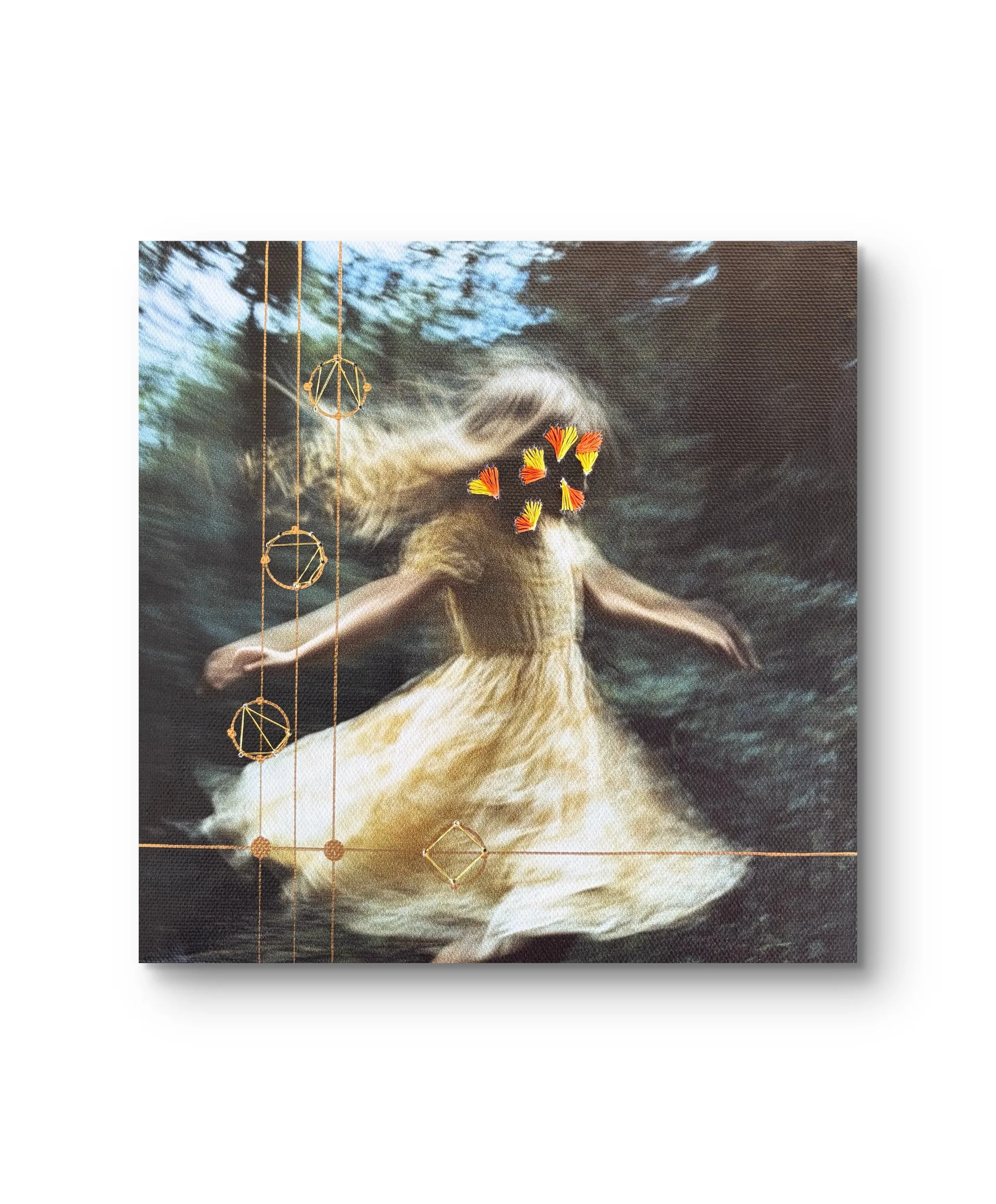 Image 2 of 5
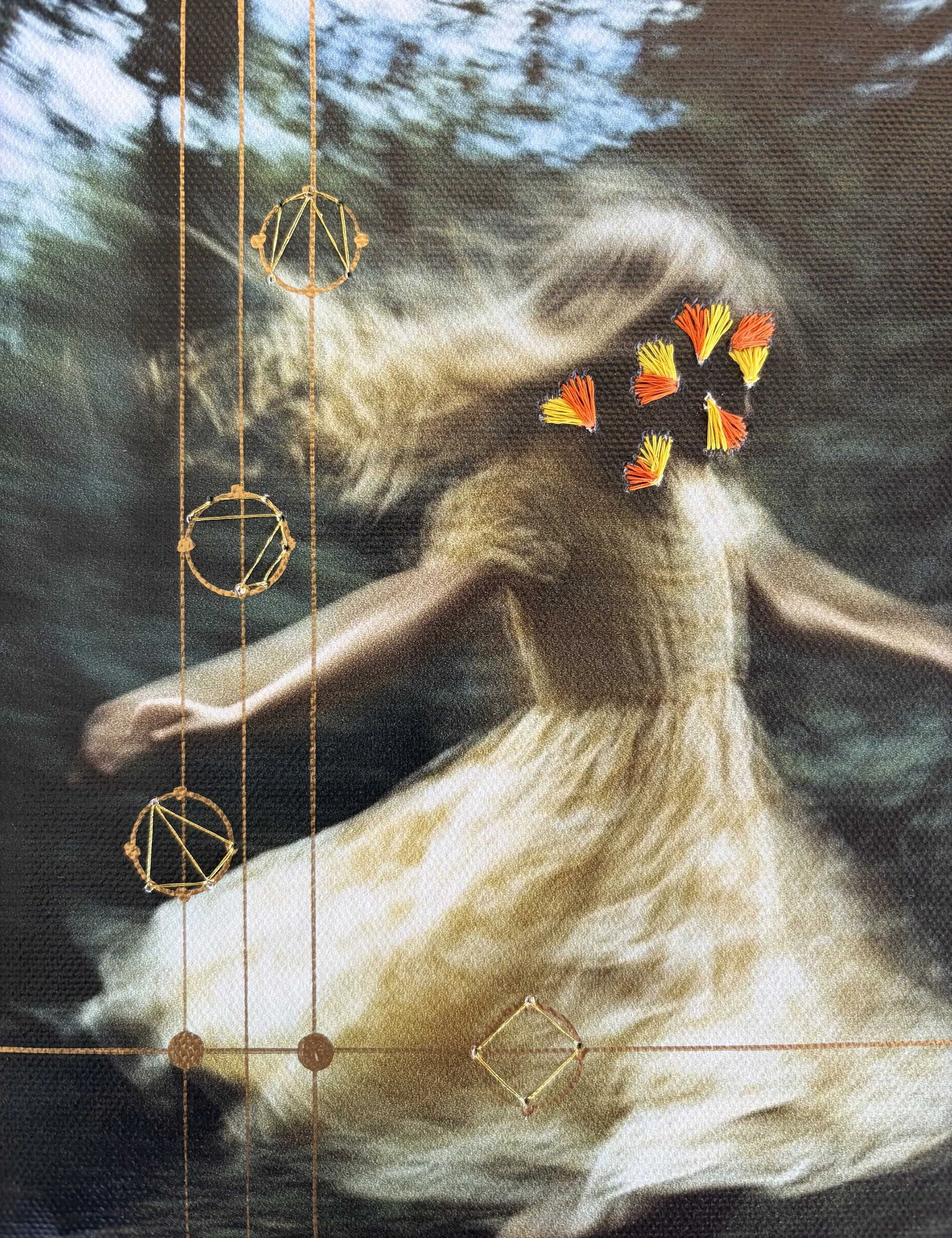 Image 3 of 5
 Image 4 of 5
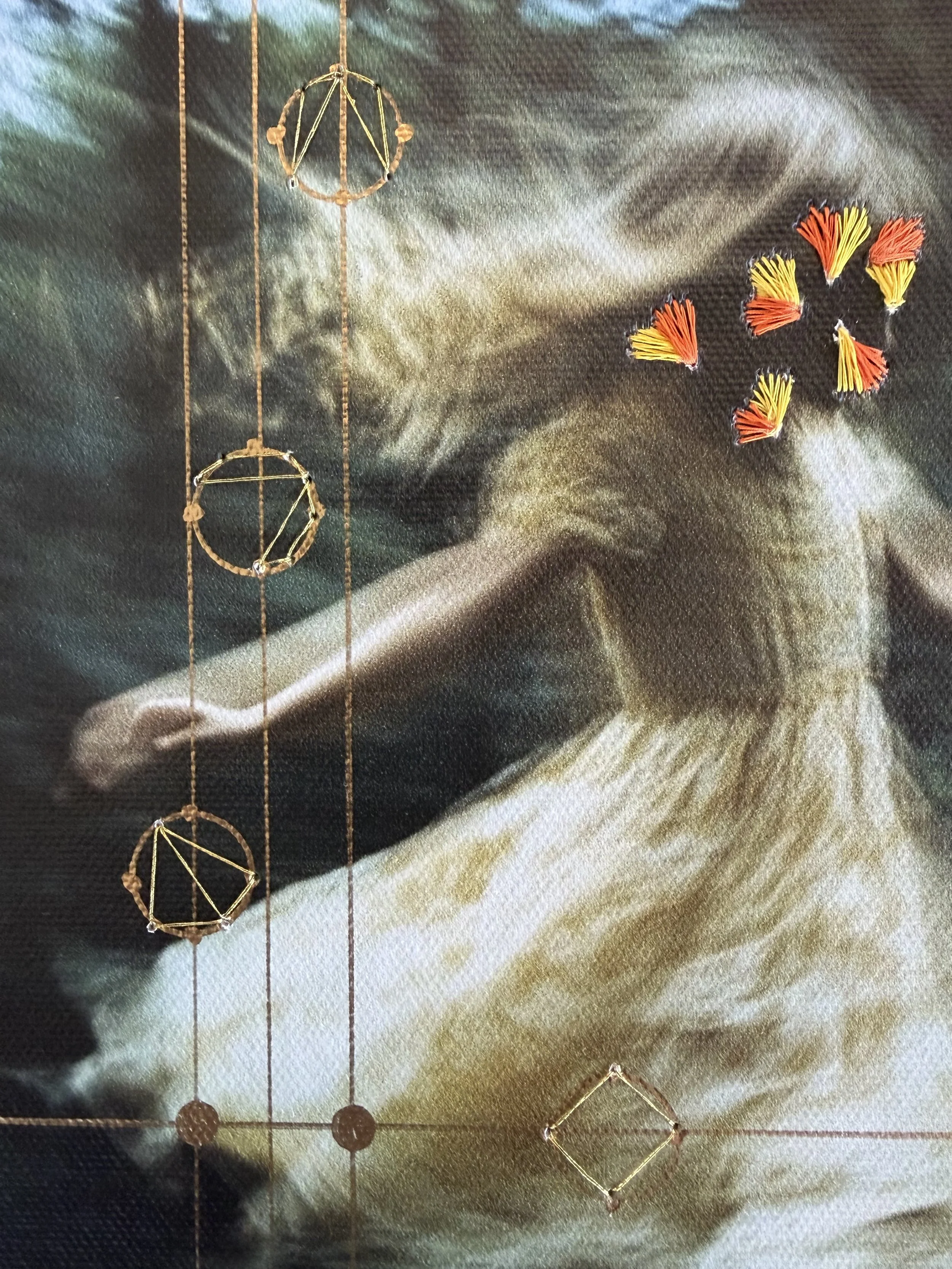 Image 5 of 5
“We experience ourselves our thoughts and feelings as something separate from the rest. A kind of optical delusion of consciousness. This delusion is a kind of prison for us, restricting us to our personal desires and to affection for a few persons nearest to us.”
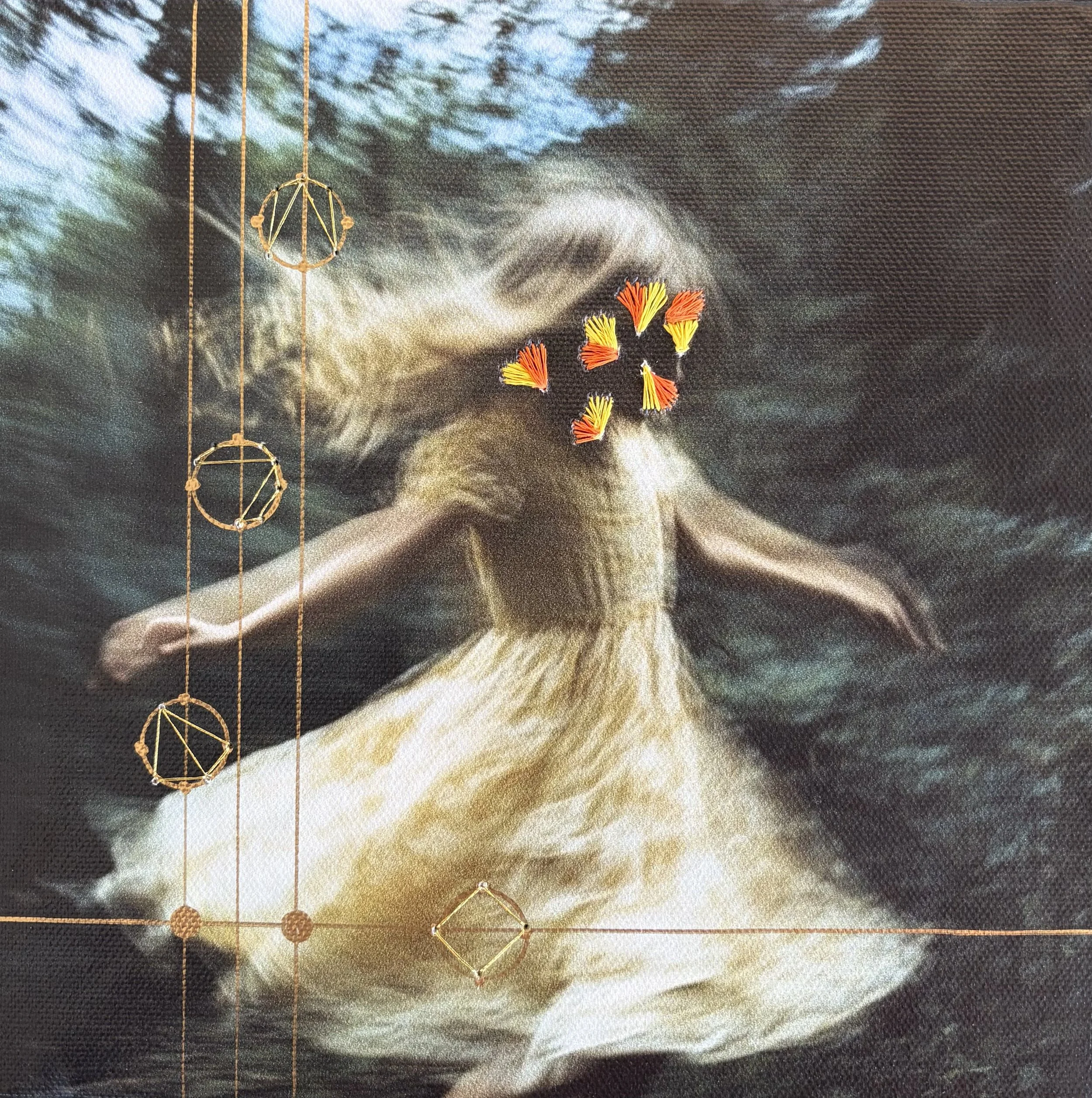
- Albert EinsteinDisplayed on an 8×8 canvas, “Who” is a scene caught between movement and erasure. A young figure spins through a forest that dissolves into motion, the trees stretching into long bands of color as if the world is being pulled apart faster than it can be understood. Her dress lifts in soft gold light, but her face refuses to resolve. Instead of features, there is a scatter of embroidered shapes that look like small flames or petals or ideas that never fully assemble into a single self.
Across the canvas runs a framework of gold lines and circles drawn from the circle of fifths. These geometric anchors behave like an outside logic imposed on a shifting interior world. Each circle carries stitched mirror notes, fragments of harmony that replicate and invert themselves. They act like the musical equivalent of trying on different identities, each one an echo of the last but not quite the same. They suggest a desire for coherence, for a structure that promises resolution, yet the figure keeps spinning past every point where that resolution could occur.
Identity disturbance in borderline personality disorder is described clinically, but the experience often feels more like this image. The self blurs. It changes direction without warning. It shifts in response to context, emotion, or memory, not out of choice but out of an instinctive pull toward whatever feels momentarily true. The embroidered bursts over the face capture that sensation of fragmentation. They hold a series of selves that cannot quite synchronize, mirror notes that refuse to settle into a single chord.
The gold grid tries to offer clarity. It behaves like a scaffolding someone might build to understand who they are and how they move through the world. But the spinning figure resists it. Her motion is not chaotic so much as unfinished, as if she is testing each version of herself, listening for the moment when an internal note finally matches the external pattern.
“Who” lingers inside that search. It reveals the tension between an inner world that keeps rewriting itself and an outer world that asks for a stable answer. The canvas holds both forces without deciding which one wins. The girl continues to turn, her face made of many possible faces, while the circle of fifths marks each point where harmony could appear. The result is a portrait that never settles, a reminder that for some, identity is not a single declaration but a shifting constellation of mirror notes still trying to find their chord.
“We experience ourselves our thoughts and feelings as something separate from the rest. A kind of optical delusion of consciousness. This delusion is a kind of prison for us, restricting us to our personal desires and to affection for a few persons nearest to us.”
- Albert EinsteinDisplayed on an 8×8 canvas, “Who” is a scene caught between movement and erasure. A young figure spins through a forest that dissolves into motion, the trees stretching into long bands of color as if the world is being pulled apart faster than it can be understood. Her dress lifts in soft gold light, but her face refuses to resolve. Instead of features, there is a scatter of embroidered shapes that look like small flames or petals or ideas that never fully assemble into a single self.
Across the canvas runs a framework of gold lines and circles drawn from the circle of fifths. These geometric anchors behave like an outside logic imposed on a shifting interior world. Each circle carries stitched mirror notes, fragments of harmony that replicate and invert themselves. They act like the musical equivalent of trying on different identities, each one an echo of the last but not quite the same. They suggest a desire for coherence, for a structure that promises resolution, yet the figure keeps spinning past every point where that resolution could occur.
Identity disturbance in borderline personality disorder is described clinically, but the experience often feels more like this image. The self blurs. It changes direction without warning. It shifts in response to context, emotion, or memory, not out of choice but out of an instinctive pull toward whatever feels momentarily true. The embroidered bursts over the face capture that sensation of fragmentation. They hold a series of selves that cannot quite synchronize, mirror notes that refuse to settle into a single chord.
The gold grid tries to offer clarity. It behaves like a scaffolding someone might build to understand who they are and how they move through the world. But the spinning figure resists it. Her motion is not chaotic so much as unfinished, as if she is testing each version of herself, listening for the moment when an internal note finally matches the external pattern.
“Who” lingers inside that search. It reveals the tension between an inner world that keeps rewriting itself and an outer world that asks for a stable answer. The canvas holds both forces without deciding which one wins. The girl continues to turn, her face made of many possible faces, while the circle of fifths marks each point where harmony could appear. The result is a portrait that never settles, a reminder that for some, identity is not a single declaration but a shifting constellation of mirror notes still trying to find their chord.